
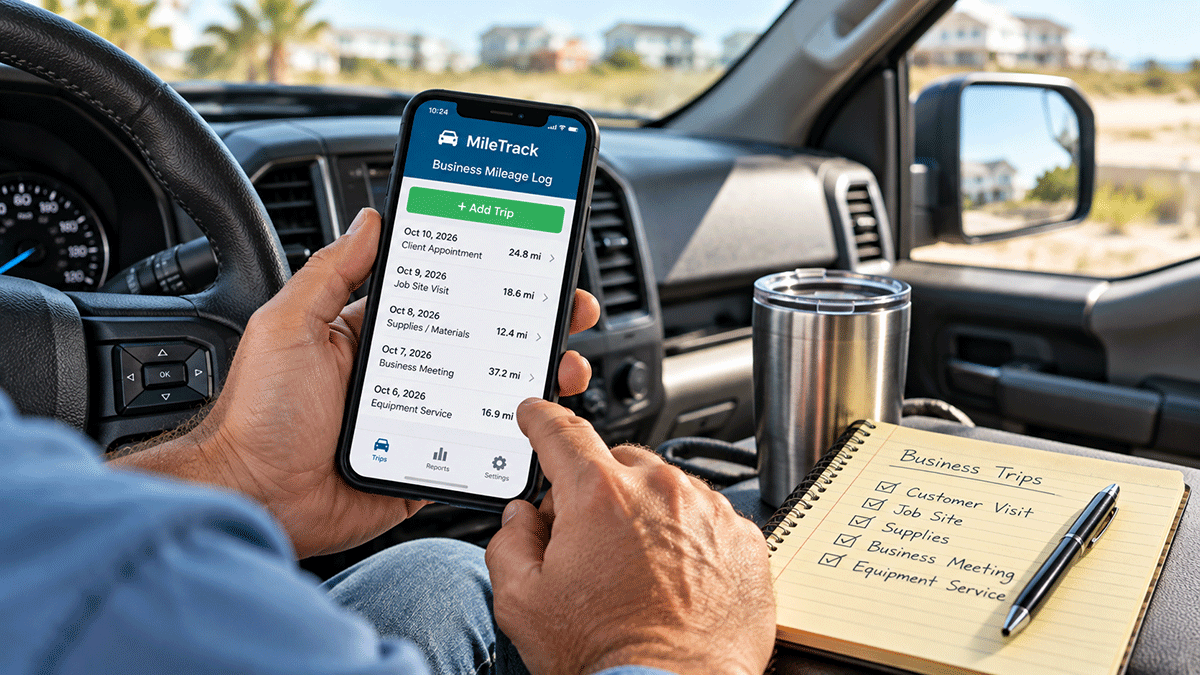
Tracking business mileage sounds simple enough. You drive to a customer appointment, visit a job site, pick up supplies, or travel to a business meeting. All you need to do is record the miles.
Unfortunately, many people discover that maintaining accurate mileage records is more difficult than expected.
Trips get forgotten, odometer readings aren’t recorded, and business mileage becomes mixed with personal driving. By the time tax season arrives, reconstructing an entire year’s worth of trips can become a frustrating exercise.
The good news is that business mileage tracking doesn’t have to be complicated or expensive. A simple, consistent recordkeeping process can make a significant difference.
Why Business Mileage Tracking Matters
For self-employed individuals, independent contractors, and small business owners, vehicle expenses can represent a significant business cost.
Depending on individual circumstances and applicable tax rules, qualifying business vehicle use may also provide opportunities for tax deductions.
However, claiming eligible mileage expenses requires more than estimating how far you drove during the year.
Accurate records help establish when business travel occurred, how far you traveled, and why the trip was business-related.
Even when mileage isn’t being tracked for tax purposes, organized records can help individuals and businesses understand their transportation expenses.
The Problem With Reconstructing Mileage From Memory
One of the most common mileage tracking mistakes is waiting until the end of the week, month, or year to record trips.
Consider a self-employed contractor who visits several customer locations each week.
During a typical month, that contractor might drive to:
- Customer appointments and service calls.
- Job sites and project locations.
- Suppliers to purchase materials.
- Business meetings.
- Equipment repair or maintenance appointments related to business operations.
After several weeks, remembering the exact dates, destinations, distances, and purposes of these trips becomes difficult.
Calendar entries and receipts may help reconstruct some information, but they don’t always provide a complete record.
The simplest solution is to record qualifying trips when they occur rather than attempting to recreate them later.
What Information Should a Business Mileage Log Include?
A useful mileage log doesn’t need dozens of fields or complicated calculations.
For each business trip, it’s generally helpful to record:
- Date: When the trip occurred.
- Starting location: Where the trip began.
- Destination: Where you traveled.
- Business purpose: Why the trip was necessary.
- Distance: The number of miles driven.
- Odometer readings: Starting and ending readings when applicable to your recordkeeping method.
For example, a mileage entry might document a trip from an office to a customer’s property for an equipment inspection.
Recording this information consistently creates a useful history of business travel.
For tax purposes, the IRS has specific substantiation requirements, so your records should satisfy the rules applicable to your situation.
Business Mileage and Personal Mileage Are Different
Not every mile driven in a personal vehicle qualifies as business mileage.
Trips undertaken for personal errands, recreation, or other nonbusiness purposes generally cannot be treated as business travel.
Travel between home and a regular workplace is generally considered commuting and is ordinarily not deductible, although specific exceptions may apply.
For individuals who use the same vehicle for both business and personal activities, distinguishing between the two is particularly important.
Maintaining separate records of business and personal vehicle use can make expense reporting and tax preparation easier.
Three Common Ways to Track Business Mileage
1. Paper Mileage Logs
A notebook or printed mileage form is an inexpensive way to record trips.
However, paper records can be misplaced, damaged, or forgotten. Calculating totals also requires additional work.
2. Spreadsheets
Spreadsheets offer more flexibility and can calculate mileage totals automatically.
They are useful for individuals comfortable with maintaining their own records, but they still require consistent data entry and organization.
Over time, managing multiple files or correcting incomplete entries can become inconvenient.
3. Dedicated Mileage Tracking Applications
A dedicated mileage tracking application provides a more structured approach to recording trips and maintaining a mileage history.
Instead of creating and maintaining your own spreadsheet, you can use a system specifically designed for mileage recordkeeping.
The important consideration is whether the application makes tracking easier without introducing unnecessary complexity.
Do You Really Need Automatic GPS Mileage Tracking?
Some mileage tracking applications emphasize automatic trip detection and GPS-based recording.
These features can be useful for people who drive frequently and want their trips detected automatically.
However, automatic tracking isn’t essential for everyone.
Someone who makes a few business trips each week may prefer a straightforward system that allows trips to be entered and reviewed manually.
Automatic tracking can also introduce additional considerations involving device permissions, battery usage, and the need to review detected trips for accuracy.
The best approach depends on how frequently you drive, how much detail you need, and how you prefer to maintain your records.
Business Mileage Tracking and Tax Deductions
The IRS generally provides two methods for calculating deductible vehicle expenses when the taxpayer and vehicle qualify: the standard mileage rate method and the actual expense method.
Under the standard mileage rate method, eligible business miles are multiplied by the applicable IRS mileage rate.
Under the actual expense method, qualifying vehicle expenses are calculated according to applicable rules, including the business-use portion of expenses when a vehicle is used for both business and personal purposes.
Eligibility, method selection, and documentation requirements can vary based on the taxpayer’s circumstances.
Because mileage rates and tax rules can change, always consult current IRS guidance on business use of a car or a qualified tax professional before claiming vehicle-related deductions.
Regardless of the calculation method, maintaining accurate records throughout the year is generally easier than reconstructing them at tax time.
Keep Mileage Tracking Simple With MileTrack
For individuals who want an organized way to maintain mileage records without adopting an unnecessarily complicated system, a focused application may be the right choice.
MileTrack, part of the DecaVault family of personal organization tools, is designed around the practical need to keep mileage information organized.
Rather than treating mileage tracking as part of a large business management platform, the idea is to focus on the essential task: maintaining useful records of vehicle travel.
Whether you’re an independent contractor, a small business owner, or someone who needs to document vehicle use, a consistent mileage tracking process can reduce administrative work and make important information easier to find.
Five Habits That Make Mileage Tracking Easier
Regardless of which tracking method you choose, a few simple habits can improve the accuracy and usefulness of your records.
- Record trips promptly. Enter mileage information as soon as practical rather than relying on memory.
- Describe the business purpose. Include enough detail to explain why the trip was business-related.
- Separate business and personal travel. Avoid treating every mile driven as a business expense.
- Review records regularly. Check for missing entries or unusual distances before too much time passes.
- Maintain supporting documentation. Keep relevant receipts, appointments, and other records when required.
Consistency is more important than complexity. A simple system used regularly is generally more valuable than an elaborate system that becomes too inconvenient to maintain.
Make Mileage Recordkeeping One Less Thing to Worry About
Business mileage tracking shouldn’t require hours of paperwork or an expensive software subscription.
For many individuals and small businesses, the real challenge isn’t calculating mileage. It’s remembering to record trips and keeping those records organized.
By establishing a consistent process and using tools appropriate for your needs, you can reduce the frustration of maintaining mileage records.
At DecaVault, we believe everyday information management should be straightforward. Whether you’re organizing personal records or tracking vehicle mileage, the objective is the same: make important information easier to maintain and retrieve when needed.
Explore More Practical Software Solutions
DecaVault helps you organize important information and simplify everyday recordkeeping. Explore our personal organization tools and other software solutions:
- DecaVault – Discover practical tools for organizing important personal information and records.
- Personal Organization Tips – Learn why simple tools can make everyday recordkeeping easier.
- Local Service Rep – Explore affordable software for service businesses, work orders, billable time, and employee time tracking.
- Rock Local Media Group, Inc. – Learn about the company behind DecaVault and our approach to developing practical software solutions.